Dance Description –Phenomenon or Fallacy
By Dr Maria Oshodi, Artistic Director & CEO
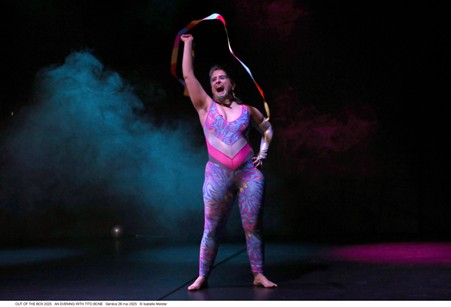
An Evening With Tito Bone, Out of the Box 2025, photo credit: Isabelle Meister.
I’ve witnessed a range of visually impaired accessible dance presentations and am involved on consulting and dramaturgy on some dance R&D’s and up-coming dance performances. The question with this form is always whether something so visual, in motion an often wordless, can be made accessible and enjoyable to audiences that can’t fully see what’s going on? Here’s my take on it from what I’ve experienced of some recent works… Not a review of the content, well only in as much as it might affect the visually impaired access…
Amici presented a moving commemoration to their founder and long-time choreographer Wolfgang Stange, and his partner George Beven, in an emotional tribute called ‘Our Time’ at the Lyric Theatre, Hammersmith. Disappointingly the 90-minute show, described as a ‘relaxed performance’, was a little too relaxed regarding access for visually impaired audiences. Front of House (FOH) weren’t sure where the audio description headsets were on arrival and when they were located and handed over as I took my seat, they were inevitably not working. I say ‘inevitably’ because this, in my 30 years of interacting with traditional audio description at arts events, is invariably the case, as temperamental headsets for audio description are often handed out in theatres. Advice – FOH staff need training to check with visually impaired audience that the equipment is working when they are seated– it is not enough to have tested it before in an empty auditorium, always the plaintive defence when this substandard customer service occurs. And, again, on this occasion it was left to me to try and locate the disappeared staff after realising I couldn’t hear the pre-programme notes on taking my seat; a task, for obvious reasons, is inaccessible. The programme notes give live information by the audio describer at the theatre over the headset to the visually impaired audience, usually 15 minutes before the show starts, about the visual appearance of characters, set and some action. Eventually the FOH staff were alerted and went to find a replacement headset, however during this time I knew I was missing critical show information as the performance start time drew closer, adding to the stress, and when a working headset was finally delivered to me, the pre-notes were over. The audio description that I did hear throughout the performance included words to convey movement, such as pivots, stretches and lunges, but being continually repeated, these terms lost a sense of meaning. This, plus the loss of description of colour and costume through the missed programme notes, flattened this traditional form of accessibility even more for me. Generally, I experience a detachment when listening to description for dance performance through headsets, as the live connection with the presence of the onstage performance is broken, drowned out and masked when an auditorium is filled with music and my ears are filled with the voice of the audio describer.
This matter was partially attended to in the next dance performance I experienced, where I also received one explanation for why describers default to repetitious language when relating to creative movement.
SADBOI, a hip-hop theatre show by Simeon ‘Kardinal’ Campbell, was presented as part of The Liberty Festival, marked by the Wandsworth Borough of Culture 2025, held at the Battersea Art Centre. This was a loud, dynamic solo exploration of a journey through neurodivergence by a hearing performer of two Deaf parents. Consequently, British Sign Language was enmeshed as an integral creative force throughout. Audio description was offered through headsets again, delivered by a live describer, and although I thought this would be problematic for the reasons given above, plus possibly conflicts with hard baselines and high volumes of music conflicting with hearing the describers voice, this was not so much the case. The describer could be heard, and the performer used their unamplified voice on stage from time to time, creating a direct point of acoustic contact for me, breaking the dance audio bubble. However, there was the same over use of limited terms by the audio describer to illustrate the dance movement. A trained sighted dancer had watched the show with me and afterwards gave me a much richer explanation of the dance movement. Later, I had an opportunity to feedback to the describer and also ask why the difference? This very experienced, well-regarded describer admitted that they just ran out of language to describe the diversity of this dance style. I later learned from the show’s producer that the artist had not read or signed off the audio describer’s script. As an Artistic Director myself, it’s my responsibility to ensure ‘all’ audiences receive my creative interpretation, rather than it being filtered through someone not on my creative team. Solution – dance creatives offering an audio described performance of their work should check the language the describer is using and that it fully expresses the intention of their piece, possibly amending and improving on a fuller range of ways of describing the movement from a trained dancers/choreographers vocabulary.
It gets better…
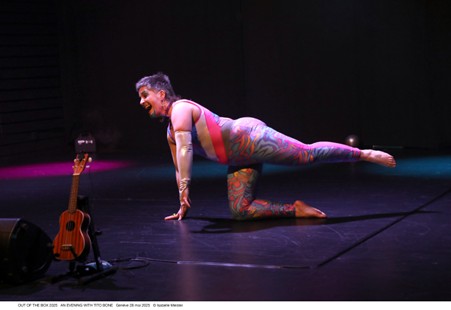
An Evening With Tito Bone, Out of the Box 2025, photo credit: Isabelle Meister.
Visually impaired dancer Holly Thomas brought her show, ‘Half Light’ to its touring performance culmination, after researching its movement, integrated description and technology over an extended period of time. The show challenged the status quo by setting the piece in an elliptical space where sound from the performer’s bodies, voices, portable speakers or contact mics inventively surrounded or moved around, in front or behind the seated audience. This supported the concept of increased reliance on sound when vision depletes, immersively explored throughout the piece alongside the parent child relationship. More movement theatre perhaps than dance, the lean into dialogue aided the integration of description, though some of the more complex movement still remained a mystery. The slightly disorganised touch tour, with performers brought on stage with little to say, and the unusual shape of the staging being left out of the description, did however include at the start an attempt to enable an understanding of some complex moves, by highlighting sequences such as a struggle between two performers, and breaking this down through description of each movement and sound cues, but this is always something tricky then to retrofit back from memory when much later the performance is in full swing.
Another visually impaired performer, Amelia Cavallo, presented a work in progress called ‘An Evening With Tito Bone AKA The World Is Burning So Please Enjoy My Drag Show’, in London and Sheffield. A solo cabaret style performance where popular songs were re-written to take a scathing swipe at the inaccessibility of the visual world, and musical theatre numbers were appropriated to express blind access to the drag world. A parody of contemporary dance was offered as part of the audio description Olympics, where some key terms used for moves were physicalised and described just before the routine began. When it did, the soundtrack integrated a pre-record of comic sung description from Tito that was integrated with the music. The voice-over description was supported with an entire range of acoustic spatialised sounds from the stage made by Tito, such as loud sighing, slaps to the floor, banging cane etc., so the visually impaired audience could track and never lost contact with where the performer was on stage. This artist says, “For the dance piece specifically, I wanted to see if there was a way to layer multiple descriptions and sounds on top of each other at the same time and for the piece to still be accessible.”. The main conflict with this fun, smart and brilliantly executed routine was the strip at the end, which inspired traditional woops and yells as it developed, but the enthusiastic volume of noise from the audience, did unfortunately interfere with hearing the access in the soundtrack.
And what of our allies…?
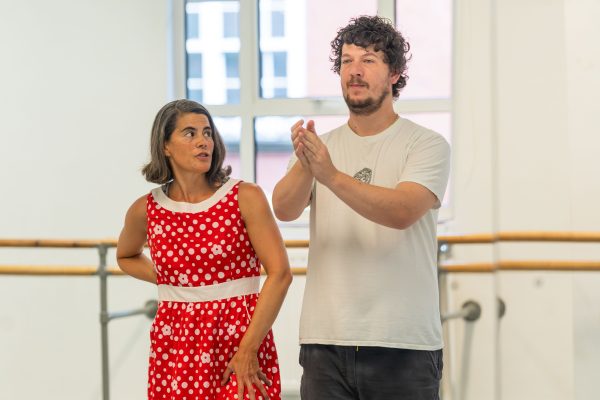
Eva Recacha and Alberto Ruiz Soler.
Excitingly some nondisabled dance adventurers have picked up the integrated AD mantel and are vitally and vigorously flexing it. Artists like Louise Ahl are commonly working with it as an aesthetic language tool in their practice. I witnessed the developing results of this when consulting on their 2023 work ‘Skunk without k is Sun’, an experimental 3 act solo opera, working with audio description as sung operatic material. This was a wild mix of provocative dance, rich choric sung layers of description, infused with disturbing startling voiced dialogue. Truly transfixing through its access, this performance offered real promise for the future of accessible dance and for visually impaired audiences. It’s encouraging that Louise has now embarked on a PhD into integrated Audio Description as a choreographic framing device for weird and experimental performance…. And I am positively anticipating what results from this and her forth-coming work.
Another example is the new collaboration between choreographer Eva Recacha and sound designer and composer Alberto Ruiz Soler. I have been consulting with them on ‘Sur’, a work in progress that puts them on stage together for the first time. They are exploring their friendship and their exile, within the breaking apart of the relationship between movement and sound. Through a series of R&D’s, workshops and thoughtful open sharing’s, they have experimented with intertwining into their choreographed narrative, mixed methods of directional acoustic and pre-recorded sound, spare and affective descriptive dialogue, and clapping or stamping percussive movement to achieve creative access. They want to deliver a textured piece where the access informs the structural and emotional intention at the core of the work.
It’s fair to conclude from these sample case studies that defaulting to traditional methods of audio description delivery through headsets for dance performances can result in a more subtractive experience for the visually impaired audience. However, integrating creative accessible aesthetics seems to be the answer to move a dance experience from being something of Fallacy to more of a Phenomenon. Visually impaired scholar and artist Devon Healy has discovered this in presenting their recent work with the Royal Ballet, in which an aesthetic they call ‘immersive descriptive audio’ features within the musical score as an attribute of blind perception. Working with a host of established choreographers for ‘World Ballet Day’ they have introduced this method, which the Royal Ballet defines as ‘radical access’. That many artists for many years have been working to integrate many forms of integrated access, whether it be audio, descriptive or immersive for visually impaired audiences, is not acknowledged by Healy, an assistant professor of disability studies at the University of Toronto. While it’s hoped that this understanding of ‘radical access’ goes further than the one world ballet day in the West End, other visually impaired artists and allies are continuing to commit, as they have been doing for years, to make creatively accessible dance a phenomenon across all of their performances.
Finally, Extant is currently working as access dramaturgs for Corali, an inclusive dance company. We hope to bring some of these above learnings to the process, and a public performance will take place on 8th March at Brixton Town Hall tracking the history of social dance in the borough of Lambeth…All are welcome to come and decide if what is presented is Phenomenon or Fallacy!
Dr Maria Oshodi, Artistic Director & CEO, January 2026