Extant’s extensive impact at Edinburgh Festival 2026 – including Meta partnership
Building on the success of our work at the Edinburgh Festival Fringe in 2025, we returned this year with a significant increase in the number of activities, partnerships and profile delivered by the entire Extant team. This impact could not have been achieved without the support of Esmee Fairbairn Foundation, Paul Hamlyn Foundation, the Postcode Society Trust and our NPO funding from Arts Council England. This is an overview of what we delivered:
- Visual Impairment Awareness Training for the Underbelly team, who were our Enhance and Showcase partner venue.
- Record Your Own Audio Introduction – two drop-in workshop sessions for artists and companies already at the fringe to learn how to write, record and upload their audio introduction, in partnership with the Edinburgh Festival Fringe Society.
- Enhance performance, touch tour and audience development for Aarian Mehrabani’s debut stand up show How’s Your Head alongside a Meet Extant social gathering for visually impaired folk in Scotland talking about VI humour.
- A sold-out industry showcase featuring seven visually impaired artists from across the UK presenting 10-minute extracts of new or existing work for national and international venue programmers, festival directors and funders.
- An international networking drinks reception, to introduce and facilitate conversations between programmers and artists.
- A new media partnership and documentary with Meta and Chris McCausland to look at where their AI glasses could play a useful role in relation to assistive tech and the Fringe experience.
“Extant is no stranger to embracing technological innovation in its enquiry into lived experience of visual impairment in the exploration of more accessible performance. This started in the late 90’s with our use of Sound Beam, to mobile phone navigation in The Cast Party (2006), and haptic technology in The Question (2010), followed by Flatland (2015).
Naturally, more recently then, we have been open to the invitation from Meta to explore the benefits of their AI smart glasses for visually impaired performers who we have been working with at the Edinburgh fringe festival. While recognising the wider debates around the use of emerging technologies in public spaces, we are supportive of the access enhancements reported by tens of thousands of visually impaired AI glasses users. Further placing these experiences through a performers lens enables the ‘Extantification’ of the debate, which we always want a creative active visually impaired voice to play a part in.” Dr Maria Oshodi.
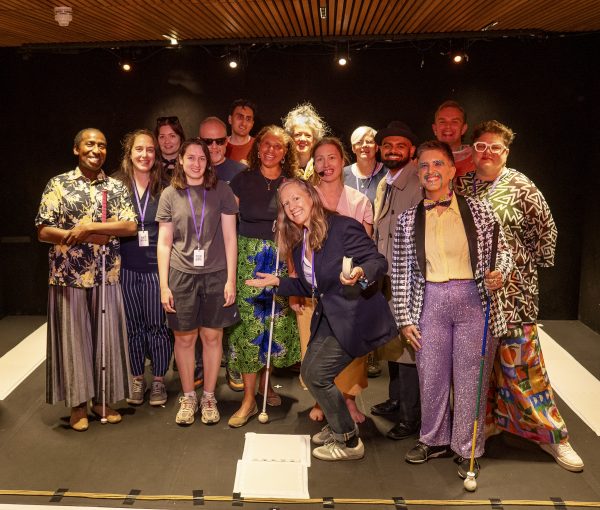
Extant visually impaired artist showcase, Underbelly, Edinburgh Festival Fringe 2026. Photography by Bip Mistry.
One of the common phrases that we often hear from non-disabled peers and programmers in the industry is: “I don’t know who to programme or where to find visually impaired artists” – like they’re some kind of rare and mythical creature. So, we wanted to solve that problem by curating and organising the first ever visually impaired artist showcase at the biggest performing arts festival in the world. Those artists were: Aarian Mehrabani, Ebony Rose Dark, Tom Skelton, Neil Skene, Shashank Sharma, Holly Thomas and Amelia Cavallo.
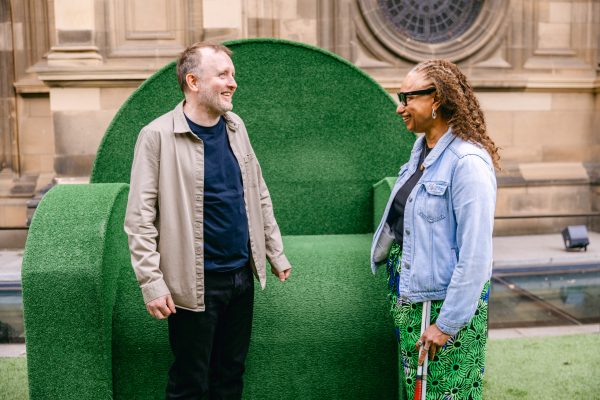
Chris McCausland and Dr Maria Oshodi, Meta & Extant, Edinburgh Festival Fringe 2026. Photography by ChewBoy productions.
It was our pioneering work on the showcase and in trying to make Edinburgh more accessible for visually impaired people which attracted Meta. Together we were interested to see how their AI glasses could play a useful role in relation to assistive tech and the Fringe experience. This was an early trial in the run-up to and during the festival, designed to give the artists space to experiment with the technology in real-world situations and share honest feedback on both what they found useful and where they encountered limitations. Two of the showcase artists (Holly and Aarian) alongside our CEO/AD Maria spent time chatting with comedian and broadcaster Chris McCausland (who shared another short film on our time in Edinburgh for his followers here) in Edinburgh and we invited our former Trainee Artistic Director Tam Gilbert to share her thoughts on the glasses before the festival too.
What Worked Well
The trial highlighted a number of ways the glasses could be useful across everyday life and the Fringe experience. Holly found the hands-free functionality useful while cooking and was able to use the glasses to read menus at Fringe food stalls, including identifying vegetarian options and prices. Aarian was impressed by the quality and discretion of the speakers and found the hands-free camera useful for capturing POV social content. Tam described making and receiving calls through the glasses as “revolutionary” and found taking photos and videos easy and enjoyable.
What We Learned
As an early trial in the run-up to and during the Fringe, the experience also highlighted areas where the technology could improve. Holly found that some visual descriptions weren’t always accurate and would have liked more support with orientation around the festival. Aarian found that creating social content wasn’t entirely hands-free once he wanted to add music, text and stickers, and highlighted accessibility considerations around the packaging. Tam found the initial setup challenging and experienced occasions where she needed to give the glasses additional prompts to get the information she needed.
Holly says: “The glasses were useful at home, enabling me to be hands free to look up methods and recipes whilst cooking. I found them helpful when trying to locate and read menus at food vendor stalls at the Fringe and was able to find vegetarian options and prices very easily from printed menus. I would have liked to have access to a GPS app to assist with orientation around the festival. Sometimes it said it would remember information and my preferences, but it was inconsistent in doing this. I asked the glasses if my costume needed ironing and it said that the clothes looked well ironed, but my access worker advised that this was incorrect. It made me wary of trusting AI when it comes to knowing if clothes are clean, free of stains and creases.”
Aarian says: “The speakers were fabulous. I was initially nervous about the speakers on the glasses as I was worried that people around me would be able to hear my voice over. However I was pleasantly surprised to find that the speakers couldn’t be heard and the quality of them was excellent. I found the camera really useful for social media content – in particular, having them on my face meant I was able to record some fab POV stories, however, I wasn’t able to post them hands free as I like to add music, text and stickers to my stories and the glasses did not allow for this. When walking around the Edinburgh food trucks, I would have to stand in front of each truck and say “Hey Meta, what type of food does this truck serve?”, I would then have to wait for the glasses to take a picture and analyse it before giving me the answer. On some occasions it would it forget the previous truck and take a new image. I found the unboxing quite inaccessible as I could not see the pull tab. These are usually easily identifiable by touch as they have some form of edge or cut out you can feel. However the glasses had a pull tab that was completely flush with the box and only had a visual mark on the box of where the pull tab was.”
Tam says: “The initial setup with the app was tricky, it took a few times to work it out and I needed some sighted support initially to pair them, and the buttons weren’t physically easy for me to access. The glasses charged quickly and efficiently, and I liked choosing between different voices. They were revolutionary in terms of making and receiving calls and I took some photos and made some videos easily which was fun to do. When I asked it about steps, it first said that there were some steps, but it needed to be prompted about the number and a further prompt for the direction of travel – it said they were going up but actually they were going down!”
The conversations with Chris reinforced that there was no single way the group used the technology: different features proved useful to different people, providing valuable insight into how wearable AI can fit alongside existing tools and support in everyday and creative settings.
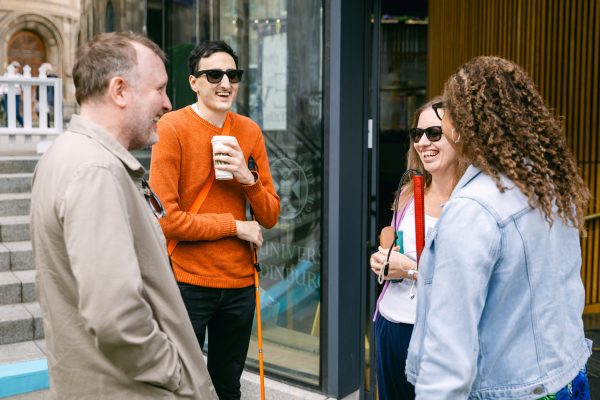
Meta & Extant, Edinburgh Festival Fringe 2026. Photography by ChewBoy productions.
We had worked hard to attract dozens of UK programmers, festival directors and industry peers to the showcase, including CEO of the Edinburgh Festival Fringe Society Tony Lankester, Emma Turner from Arts Council England, Kim Simpson from Creative Scotland, Alex Misick from Take Me Somewhere and Nick Williams from Woolwich Works. But sometimes, it’s helpful to get an international perspective on the work you do and the value that it provides for the wider industry and that’s where Emilia, Jasmine and Sangmi – who were new to the work of Extant – come in and who have so generously agreed to share some thoughts.
Emilia Lee, Deputy Director (Programming) from Modu Art Theatre, Korea said: “We had made the Extant showcase one of the key points around which we planned our visit to Edinburgh. From the perspective of a public agency working to support and develop the disability arts ecosystem in Korea, the showcase gave us a great deal of insight. I am very grateful to Extant for creating this opportunity. Watching this showcase made me think that the form [stand-up comedy/theatre] could offer something beyond being simply another performance genre. It could be an interesting catalyst for disabled artists to develop confidence in speaking to an audience, find new points of connection with artistic practice, and explore what it means to position themselves as performers.”
Jasmine Poon, Assistant Programme and Outreach Manager for No Limits, Hong Kong said: “The most valuable part of the Extant showcase was its dedication to presenting exceptionally talented visually impaired artists to a wider international audience. No Limits and Extant could collaborate through artist and programme exchanges, where Extant introduces artists/shows that No Limits can present in Hong Kong. Extant could also serve as a potential speaker at the No Limits symposium exchanging valuable experience regarding their theatre accessibility training.”
Sangmi Lim, Programme Officer (Disability Arts Funding Programme Operation Dept), Korea Disability Arts and Culture Centre, Korea said: “This was my first experience of attending a showcase dedicated specifically to disability arts. I had been accustomed to seeking out individual performances, so I was very impressed by the opportunity to encounter a range of work by disabled artists in one place, presented in short and impactful formats. It allowed me to quickly grasp the distinctive qualities and strengths of each work within a relatively short period of time, and I found it a very effective way of identifying the works and artists I wanted to explore further. The networking session immediately following the showcase, gave us the opportunity to meet and speak directly with the artists and companies and Extant made it easy to start conversations with people we were meeting for the first time. I was deeply impressed to see disability arts brought together and presented in this way within the context of such a major international festival.”
The UK has an enviable international reputation for the number of disabled artists it has supported over the last 20+ years and the quality of work they produce, but there is and has been a genuine gap in the visibility and distribution of visually impaired artists in that timeline at venues and festivals. The Extant Showcase is one way in which we are trying to close that gap and examine what really needs to happen to make festival spaces accessible for visually impaired artists and audiences.
We know that our training for venues in a festival context is strong, some of the Underbelly team reflected on this saying: “I felt like I learned a lot of new information which has helped me with my job. The training was delivered well, I enjoyed the interactive aspects and the speaker delivered key points in a clear and often fun way.” “It really helped me to consider how different customers experience performances and how best to help should I be asked.”
The feedback from visually impaired audiences who came to the touch tour for How’s Your Head? was equally positive: “I really appreciated the level of detail of visual elements, particularly the presentation slides and how the slides and props were so well contextualised. I could refer very easily to the info from the touch tour in the show.” “The fact that Enhance is blind led is fab, it is more comprehensive, it is more engaging to listen to, and it encourages AD and access to be a creative act as well as an equitable one.”
From training venue staff, to building trust and attracting audiences, to finding the right artists to put into a showcase environment, to having the network and influence to attract programmers and having the team to deliver it all in the largest and most inaccessible performing arts festival in the world is a significant amount of work (you can read all the press coverage secured by our PR company Chloe Nelkin Consulting here).
So we were delighted that Maria was nominated and received the Disability Champions Award from Neurodiverse Review Awards 2026 in recognition of our work this year. Thank you to Jodie Adams, Senior Programme Manager at Underbelly, who was able to accept the award on our behalf and shared a short acceptance speech which Maria had written (you can view the speech here) which finished with: “Maria now challenges all festivals to adopt a similar practice to that which Extant has championed at Edinburgh. Huge thanks to the panel for this award, which will help to spread her message.”
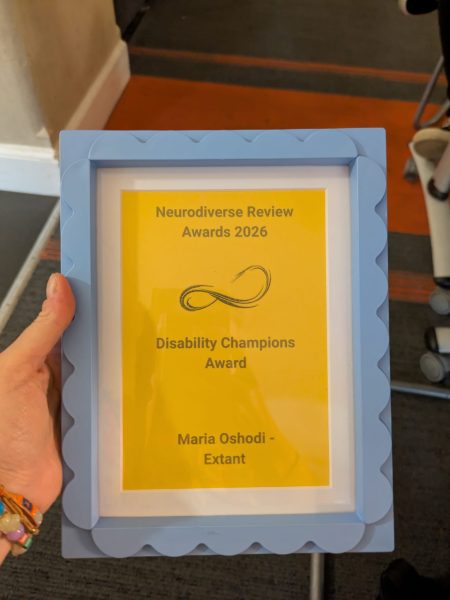
Neurodiverse Review Awards 2026, Disability Champions Award, Maria Oshodi – Extant, photography credit: Jodie Adams.