Heliocentric Revolutions and Universal Design
By Dr Maria Oshodi, Extant Artistic Director & CEO.
Universal Design in Performing Arts Conference, June 2026.
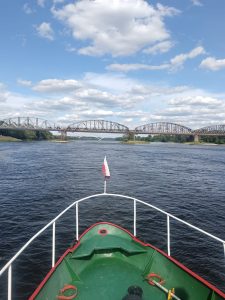
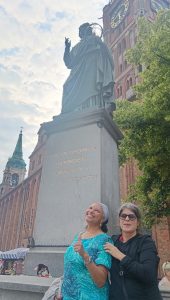
The regional cultural centre in Torun, Poland invited me to contribute to their international conference, Universal Design in Performing Arts in early June 2026. This marked the culmination of their Universal Art Design (UAD) project that had worked with 36 artists from Poland, Italy, and Serbia and was funded by the European Union’s Creative Europe programme. Conference hotels and venues were situated around the beautiful wide Vistula River and the tranquil boulevards surrounding Toruń’s historic medieval walled and cobbled town. Toruń was the birthplace of Nicolaus Copernicus, an early sixteenth century mathematician and astronomer, who in his time introduced revolutionary models that shifted fundamental design thinking about the universe.
Universal Design in Performing Arts Conference, June 2026.
“We have developed a Model that treats universal design not as a technical addition, but as a profound political gesture and a fundamental artistic language.” – Katarzyna Pągowska and Magdalena Jasińska.
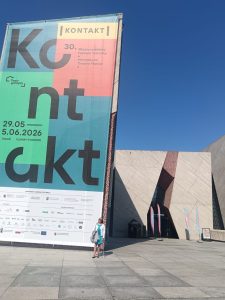
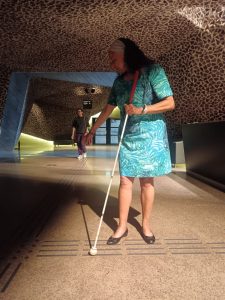
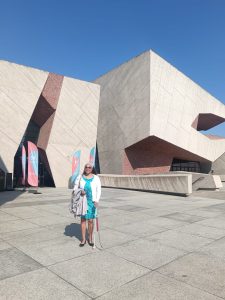
The conference was held in collaboration with the Wilam Horsecar Theater in Toruń as part of the 30th KONTAKT International Theater Festival, and the opening event was held at The CKK Jordanki Cultural and Congress Centre. This is an award-winning building, recognised for its unusual interior cave-like architectural aesthetics and accessible design. For too many years, my chief bugbear regarding buildings and their access has been why don’t architects include tactile floor surfaces in their thinking as a way-finding aesthetic feature? The Spanish architect Fernando Menis included this in their design for the celebrated building in Toruń, much to my surprise and delight, as it allowed me to feel more independent, confident and relaxed being able to follow the tactile markings from entrance to lift etc.
Universal Design in Performing Arts Conference, June 2026.
Universal Design in Performing Arts Conference, June 2026.
Katarzyna Pągowska, Deputy Director of the regional centre in Toruń and conference organiser, together with researcher Magdalena Jasinska, co-authors of ‘Art By and For All’, explained in their opening keynote:
“We were inspired by Ronald Mace, the originator of the idea of universal design in architecture. Just as he ensured that accessibility in buildings ceased to be an “add-on” and became an integral part of space, combining utility with aesthetics, we want accessibility to become the foundation of the creative process and a new artistic language.”
They went onto outline the ten steps that formed the model of the key principles of universal design in performance practice, which were created by the 36 collaborative international artists. They clarified:
“One might say that all of this has been seen before, and that every type of experience we developed has already appeared somewhere else. However, we believe that this model is the first to gather these scattered pieces into a complete whole, proposing a more conscious approach to art based on sensitivity and fairness for those who create theatre.”
And:
“Our model does not merely speak of a change in the language of theater—it begins to speak of a change in theater itself.”
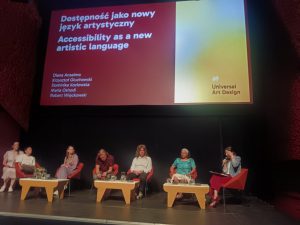
Universal Design in Performing Arts Conference, June 2026.
I certainly agreed with this, when hearing that Step 3 was to “Change power relations. Universal design transforms relationships – between the creator and the co-creator, between the stage and the audience, between the institution and the artist. It challenges hierarchy. It requires abandoning the model in which one person (most often the director) holds the most powerful position and decides on everything.”
This approach of directing through consent is a current practical enquiry in crip performance culture, and a conversation which I have been engaged in of late, with Jamie Hale of CRIPtic Arts, and while on a recent conference panel with Kelsie Acton who has written in depth on the subject. Further, while listening to the rest of the 10 steps, I pondered on what aspects of disability aesthetics could a coalition of other marginalised groups under the universal design umbrella ‘gain’ from?
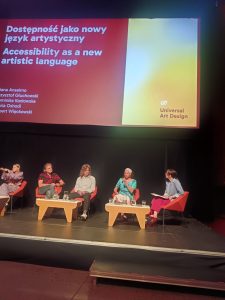
Universal Design in Performing Arts Conference, June 2026.
I then joined the discussion panel, ‘Accessibility as a New Artistic Language’, which immediately followed the keynote, and was chaired by Katarzyna Pągowska. It was a relaxed, fluid conversation, for which I was not required to deliver any formal presentation, instead invited to expand on the following idea…
‘Extant is famous for pioneering Integrated Audio Description, where the description is no longer a technical service in headphones, but a natural, poetic part of the dialogue, sound design, and performance heard by the entire audience. How do you use this method to build a completely new artistic language? How does it expand the imagination of both blind and sighted viewers? Universality through different senses: How can we design a performance based on non-visual senses (sound, touch, space, and rhythm) so that these tools are not seen as a “compromise” or an “add-on” for a specific group, but rather as a full, rich aesthetic experience for every single visitor?’
Having spoken on this, I found the rest of the panel were a diverse range of disabled and nondisabled specialists. Diana Anselmo – a queer, Deaf performer and visual artist from Italy described their radical performance practice, while conversely, Dominika Kozłowska the first Deaf on staff actor at the Juliusz Słowacki Theatre in Kraków, accompanied by the non-disabled Artistic Director Krzysztof Głuchowski of the same theatre, spoke about non-identification with the wider deaf community through a super crip exceptionalism. Robert Więckowski, visually impaired Vice-President of the Culture Without Barriers Foundation addressed disabled audiences. It’s fair to say that representing the broadest points on the disability evolutionary spectrum resulted in some points of convergence and departure among the panelists
The second panel, chaired by Magdalena Jasinska, included representatives from Finland, Poland and Serbia working across festivals, opera, journalism, social activism, and inclusive art. This panel became emotionally charged with direct challenges by one contributor about tokenism regarding disabled leadership within arts institutions. It prompted me to voice in the Q&A that isolation is a major issue when it comes to disability leadership advocacy, and the UK has had over 40 years in this field to strengthen networks and grow supportive communities. It took me aback when one of my visually impaired panellists was surprised to hear that ‘all’ the performers working with Extant were visually impaired!
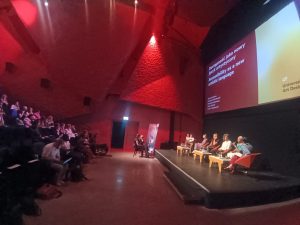
Universal Design in Performing Arts Conference, June 2026.
Later we were taken to a staged production called ‘Gorgon Syndrome’ from the Poland and Belarus NODOstage group, created as an example of the UAD project framework by a range of marginalized artists (older people, refugees etc) The production integrated a Polish Sign Language interpreter as an integral, dramaturgical element of the performance’s structure. Being able to have experienced one of the other UAD projects “such as Zbroja,” by Teatr Polski, which was not available, but described in ‘Art by all and for All’ as “Audio description becomes the main text of the performance and takes the form of the inner monologue of a puppet – a stage form that “speaks” the experience of the body. Combined with tactile elements such as casts of performers’ bodies, the performance creates a multi-sensory path of reception, one in which words, touch, and sound complement each other, making accessibility an integral part of dramaturgy.” Would have been personally more engaging for me. I had some questions about Gorgon Syndrome, in that, other than an audio intro, there was no touch tour of set or costumes, and why were there no deaf performers in the show?
At the networking brunch held the next day at Toruń’s boho cafe Wejściówka, for all the conference delegates from Germany, Lithuania, UK, Italy, Serbia, and Poland, there was an opportunity at this more intimate gathering to receive some answers. Introductions to practice, ideas and reflections on conference themes and beyond were shared, and I learnt that the NODOstage group had independently chosen to develop their work around a particular signer and build this form of access into their show. I also learned about the Bauhaus interest to creative accessibility for its exhibitions, the Lithuanian desire to learn more about integrated audio description within productions, Diana Anselmo’s work on bringing hidden anti-histories to the fore, Vienna’s inclusive flat management structure at one of its major theatre houses, and the Polish facilitators dedication to further action around UAD. In the knowledge that Extant can be said to have, or be in the process of achieving all 10 steps.
I suggested that next actions could take the shape of a future call out across Europe to organisations to present some of the ways in which they are demonstrating the ’10 Steps’ in their work…
Universal Design in Performing Arts Conference, June 2026.
However, in making my suggestion, I knew that this was as far as I could go, being reminded, while in Poland, that this month is the 10th anniversary of the UK voting for Brexit. Evidence is everywhere of this country’s strengthening economy, in contrast with the UK’s exclusion, fragility and incoherence, resulting from our severance. As a result, we can no longer take the lead in such EU initiatives. As Copernicus wisely noted, the universe no longer revolves around us! In contrast we need to be invited back in to participate and warm ourselves at Heliocentric EU environments like the one in Toruń, where participation, possibility and energy are richly supported.
And yet, in spite of the wholesale damage we inflicted on ourselves as a country and to our artists and sector back in 2016, the UK still has a long and strong disability cultural heritage led by artistic innovation, that is still thriving in spite of austerity, cuts, culture wars and reduction to PIP and Access To Work. This means we will always have something of importance to contribute, and always be invited back to the universally designed table, one that is made up of consensus and many voices.
Universal Design in Performing Arts Conference, June 2026.
By Dr Maria Oshodi, Extant Artistic Director & CEO, June 2025